GEO vs SEO: what changes, what stays, and where to invest first
Generative engine optimization does not replace SEO. It adds a second target on top of it: being named inside AI answers. What that changes in practice, and where the next unit of budget should go.
- GEO does not replace SEO. Google’s own guide says optimizing for generative AI search is still SEO, and the crawlable, authoritative content that ranks is what AI engines retrieve from.
- What changes is the unit of competition. SEO competes for a position in a list; GEO competes for a claim and a brand mention inside a generated answer, often with no click.
- The strongest citation levers are evidence and third-party presence. In controlled research, quotations, statistics and cited sources lifted visibility 30 to 40%, and keyword stuffing did nothing.
- Invest in order. Fix the SEO foundation first, then evidence-style content and off-site presence, then the landing experience for the few, high-intent visitors AI sends.
GEO is not a replacement for SEO, and it does not need a separate budget line to start. Keep the SEO foundation, because AI engines retrieve from the same crawlable, authoritative pages that rank, then add what generative answers reward: claims backed by evidence, a brand that third parties mention, and measurement that does not depend on clicks. Invest first where your buyers already compare options inside AI tools, and where you are retrieved but not named.
The definition, in two sentences. Generative engine optimization (GEO) is the work of getting your brand and your claims named and cited inside AI-generated answers, in ChatGPT, Perplexity, Gemini and Google’s AI features. SEO is the work of ranking pages in a list of results; GEO runs on top of it.
The decision for a founder or marketing lead is therefore not “SEO or GEO”. It is how much of next quarter’s effort moves from ranking more pages to being named in answers, and what to do with the visitors those answers send. The conversion event used in this article is the lead (a demo request or enquiry); where a study measures purchases instead, it says so.
What changes and what stays
The target moves from a position in a list to a claim inside a generated answer. Almost everything that earns the position still applies. Google’s guide to optimizing for generative AI features (published May 2026, last updated 10 July 2026) is direct about it: “From Google Search’s perspective, optimizing for generative AI search is optimizing for the search experience, and thus still SEO.”

A generative engine runs three steps that classic search collapses into one. It retrieves candidate sources, synthesizes them into an answer, and cites a subset. SEO has spent twenty years on retrieval. GEO targets the two steps after it. Ask Google for the best B2B intent data platforms and it returns ranked links. Ask ChatGPT and the model writes a comparison naming a handful of vendors. If your page is retrieved but your claims are not extractable, or your brand is not corroborated elsewhere, you are in the index, not in the answer.
| Dimension | SEO | GEO | Verdict |
|---|---|---|---|
| Unit of competition | A ranked URL | A claim or brand mention inside an answer | Changes |
| Success metric | Position, click-through rate, sessions | How often you are named and cited across sampled answers | Changes |
| Where the decision happens | On the results page, then on your page | Inside the answer, often with no click | Changes |
| Stability | A rank is roughly stable day to day | Each answer is generated fresh | Changes |
| Technical base | Crawlable, indexable, well-structured pages | The same pages | Stays |
| Content standard | Helpful, original content | The same, with claims that can be lifted and attributed | Stays, with a higher bar |
| Authority | Links and reputation | Links, reputation and third-party mentions | Stays, and widens |
The same guide lists what you do not need. “You don’t need to create new machine readable files, AI text files, markup, or Markdown to appear in Google Search”, structured data “isn’t required for generative AI search”, and there is “no requirement to break your content into tiny pieces”. What it asks for instead is valuable, non-commodity content and a clear technical structure. For the vocabulary around these terms, see the difference between SEO, GEO, AEO and LLM optimization.
Google’s guide speaks for Google Search and its AI features. ChatGPT, Perplexity and Claude run their own retrieval and are not bound by it, so the off-site evidence in the next sections comes from independent studies of those engines.
Why ranking first does not get you cited
A page can rank first and never be cited, because the engine awards citations on different grounds than it awards rank. The cleanest evidence is the GEO study by researchers at Princeton and IIT Delhi (presented at KDD, August 2024). It tested nine content changes on 10,000 queries, on a simulated generative engine and on Perplexity. The best performers, adding quotations, adding statistics and citing sources, improved visibility by 30 to 40% on the study’s main metric. Keyword stuffing offered “little to no improvement”.
The detail that matters for budget is who gained. Citing sources raised visibility by 115.1% for sites ranked fifth in the underlying results, while the same change lowered visibility for sites ranked first by 30.3%. Generative answers redistribute attention from the top result to lower-ranked pages that read as evidence. If you rank first, GEO is partly a defensive job. If you rank fifth, it is an opening you would not get from rank alone. How to show up in an AI answer when you have never ranked for the question covers that case.
The second difference is that answers are non-deterministic. A rank can be checked tomorrow with a similar result. SparkToro and Gumshoe (January 2026) ran 2,961 prompts 60 to 100 times each and found that ChatGPT and Google’s AI Overviews each returned the same list of brands less than 1% of the time. You are optimizing for the probability of being named across many answers, not for a fixed slot, which is why GEO needs its own measurement.
Generative answers redistribute attention from the top result to lower-ranked pages that read as evidence.
What earns citations, on and off your site
On the page, write claims a model can lift. Off the page, be a brand that others mention. SE Ranking’s study (November 2025, updated March 2026) of 129,000 domains found that sites with more than 32,000 referring domains were 3.5 times more likely to be cited by ChatGPT than sites with up to 200. Domains with millions of brand mentions on Quora and Reddit had roughly four times the chance of being cited, and domains listed on several review platforms (Trustpilot, G2, Capterra, Sitejabber, Yelp) earned 4.6 to 6.3 citations against 1.8 for domains absent from them. Whether backlinks still matter for LLMs goes deeper on the link side.
Distribution shows the same direction on thinner evidence. A Stacker and Scrunch test (December 2025) saw the AI citation rate of stories rise from 8% to 34% when they were republished across third-party news outlets. The sample was eight articles, and Stacker sells distribution, so read it as a signal, not a benchmark.
Placement inside the page matters too. Kevin Indig’s analysis, reported by Search Engine Land in February 2026, found 44.2% of citations came from the first 30% of the content, 31.1% from the middle and 24.7% from the final 30%. A statistic buried in the conclusion is worth less than the same statistic in the opening.
Common mistake: treating third-party presence as something to manufacture. Google’s guide says that “seeking inauthentic ‘mentions’ across the web isn’t as helpful as it might seem”. The presence that correlates with citations is the kind you earn: reviews from customers, answers in communities where your buyers ask, coverage in trade press.
Why clicks stop measuring it, and what to track
Most of the effect of GEO happens where your analytics cannot see it, because the answer often ends the search. Pew Research Center (July 2025, browsing data from 900 US adults) found that people clicked a traditional result in 8% of Google visits with an AI summary, against 15% without one, and clicked a link inside the summary in 1% of visits. This is the zero-click problem at a larger scale: a model can recommend you to a thousand buyers and your analytics will show few of them.
The visits that do arrive are a small share. Conductor’s 2026 benchmarks report (data from May to September 2025) puts AI referral traffic at 1.08% of all website traffic, with 87.4% of it coming from ChatGPT. Grading GEO on sessions alone reads the wrong instrument.
- Visibility. Write a fixed set of the prompts a buyer would use, by category, comparison and problem. Run each several times on each engine on a schedule and record how often the brand is named. Treat the result as a rate, not a yes or no. How your company ranks on ChatGPT and Perplexity shows the manual version.
- Referral. Segment AI referrers in analytics so those sessions stop hiding in direct traffic. For Google’s own AI features, the guide points to the Generative AI performance report in Search Console. Whether AI is taking traffic from Google on your site is an empirical question you can answer here.
- Conversion. Report the lead rate of AI-referred sessions apart from organic search, because the two behave differently and the blend hides both.
Prompt sampling measures the prompts you thought of, not the ones buyers actually type, and last-click reporting undercounts a channel that mostly assists a decision made elsewhere. Use the three layers as a trend, not as an exact share of voice.
Do AI-referred visitors convert?
The evidence is split, and the split follows the conversion event. Where the action is a lead or a signup after a considered comparison, AI-referred visitors tend to convert at or above the organic rate. Where the action is a purchase in an online store, the largest study has them converting below it. Seven published datasets, with their limits:
| Source and date | Sample | Conversion event | Finding |
|---|---|---|---|
| Ruler Analytics, May 2026 | 5 million+ conversions, 13 industries | Qualified lead or sale | AI referral 5.8%, organic search 4.9% |
| Seer Interactive, June 2025 | One client, October 2024 to April 2025 | As defined by the source | ChatGPT 15.9%, Google organic 1.76% |
| Webflow, via Growth Unhinged, November 2025 | One company | As defined by the source | ChatGPT traffic converts at 24%, six times Google |
| Ahrefs, June 2025 | Its own site | Signup | AI search visitors convert at 23 times the organic rate |
| Amsive, September 2025 | 54 sites, six months | As defined by the source | LLM 4.87%, organic 4.60%, difference not statistically significant |
| Contentsquare, March 2026 | 99 billion sessions | As defined by the source | AI-referred traffic converts at 1.3%, low against other channels |
| Search Engine Land, October 2025 | 973 e-commerce sites | Purchase | Organic search converts 13% better than ChatGPT referrals |
Two cautions. Single-company results (Seer, Webflow, Ahrefs) describe one funnel each and should not be read as benchmarks. And every figure is last-click or close to it, which understates a channel that often shapes a shortlist and lets another channel close.
The practical reading: AI referrals are low in volume and arrive mid-decision, so what they are worth depends on what they land on. That holds in e-commerce too. Tinggly, an experience gifts store, converts AI traffic at 2.4% against a 0.3% site average, the opposite of the e-commerce study above.
Whether to optimize your website for humans or AI agents takes the landing side further, and the mobile blind spot of AI search covers the e-commerce case.
Where to invest first
Put the next unit of effort on the first layer that is failing: foundation, then presence in answers, then the landing experience. GEO pays when buyers research inside AI before they buy and when the brands named for your category are not yet fixed. It underperforms almost everywhere else.
| Your situation | Invest first in | Why |
|---|---|---|
| Key pages are thin, slow or poorly linked, and the domain has few referring domains | SEO foundation and authority | Citation is gated by retrieval and by corroborated authority. On-page GEO work cannot make up for it. |
| You rank well, and sampled buyer prompts rarely name you | Evidence-style content and earned third-party presence | This is the citation gap. Lower-ranked pages that read as evidence are taking the mentions. |
| You are named and cited, and AI-referred visits do not become leads | The landing experience | The visitor arrives mid-decision. A page written for a cold visitor wastes the citation. |
| Buyers reach you through brand and transactional queries | SEO and conversion, not GEO | A buyer ready to act wants the product page or the booking form, not a synthesized comparison. |
Buyers who run considered, comparison-heavy journeys are where AI shortlisting concentrates, which is why B2B software and other high-consideration purchases see the strongest case. For Google specifically, how to optimize for AI Overviews covers the queries where an AI summary appears. And because GEO runs on the SEO base, the SEO and CRO guide remains the starting point for pages that already rank.
When AI referrals are around 1% of traffic and the business needs a large pipeline increase this quarter, GEO is a real but slow bet. Converting more of the traffic you already have will move the number faster, including on sites with modest traffic.
How Pathmonk earns the mention and converts the visit
GEO gets your brand named inside an AI answer. Pathmonk works on both sides of that mention: earning it, and converting the visitor it sends. Pathmonk’s GEO automation and SEO agent draft content on your first-party behavioral data and Company DNA, so articles carry the signals the research rewards: claims stated early, attributable figures and a consistent description of who you are and what you sell.
Website MCP covers the step GEO alone does not. It exposes your brand and your conversion actions through the Model Context Protocol, so a buyer in ChatGPT, Claude or Perplexity can act from inside the conversation. For the visitors who do click through, the real-time intent engine reads behavior, predicts the buying stage and serves a matching microexperience: proof and a path to convert for a decision-stage arrival, orientation for someone earlier. Each one is measured against a control group, so the lift is counted per card.
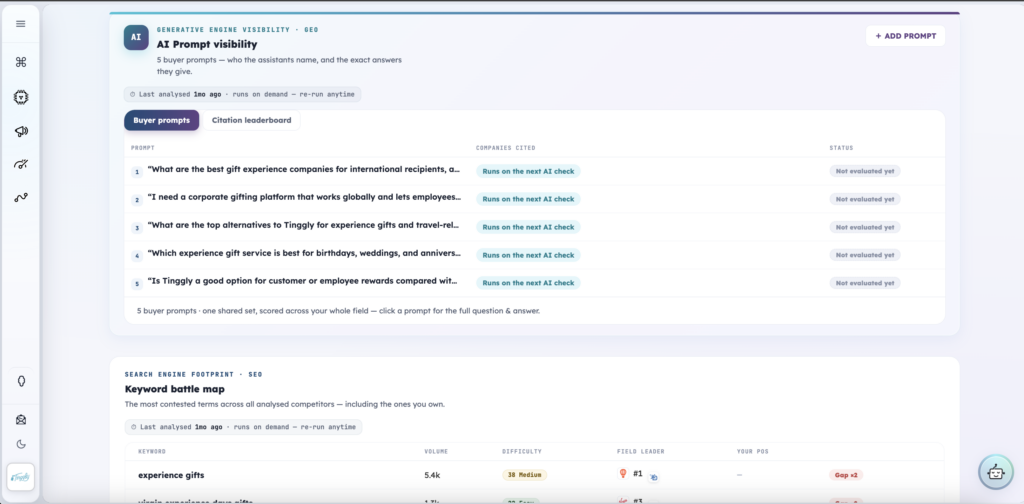
Across Pathmonk AI Search customers, the average lift in sessions arriving from AI assistants was +28% over the first three months, measured in their own Pathmonk analytics, with AI answer citations up 122% on average. Individual results from the same page:
| Customer | Sector | Result | Period |
|---|---|---|---|
| Tinggly | Experience gifts e-commerce | +121% AI-referred sessions | Against the previous 23 days |
| Yapa Explorers | Travel | +21% traffic from AI search | Months 1 to 3 |
| Care4Dental | Dental | 4 of 5 buyer prompts name the brand | Month 3 |
| Allure | Medical clinic | +148% AI answer citations | Months 1 to 3 |
Go deeper: the AI Search cluster
This page is the hub for the AI Search cluster. Each article below answers one narrower question. Sub-themes without an article yet will be linked here as they are published.
| Sub-theme | The question it answers | Read |
|---|---|---|
| GEO vs SEO | What do SEO, GEO, AEO and LLM optimization each mean? | SEO, GEO, AEO and LLM optimization compared |
| Google AI Overviews and AI Mode | What should you do about Google’s AI summaries? | Optimizing for Google’s AI Overviews |
| Getting cited in ChatGPT and Perplexity | How do you appear in an answer you never ranked for? | Showing up in an AI answer |
| Measuring AI visibility | Is AI taking traffic from Google on your site? | Is ChatGPT taking traffic from Google? |
| Converting AI-referred visitors | Who is the website for now? | Humans or AI agents |
| AI search for e-commerce | Where do online stores lose AI-referred shoppers? | The mobile blind spot of AI search |
Key takeaways
- GEO does not replace SEO. Google’s guide calls optimizing for generative AI search “still SEO”, and AI engines retrieve from the same pages that rank.
- What changes is the unit of competition: from a URL in a list to a claim and a brand mention inside an answer.
- Ranking and citation are separate decisions. In the Princeton and IIT Delhi study, citing sources lifted fifth-ranked sites by 115.1% and lowered first-ranked sites by 30.3%.
- The strongest levers are evidence on the page (quotations, statistics, cited sources) and earned presence off it (referring domains, reviews, community mentions).
- Answers change from one run to the next, so measure the rate at which you are named across sampled prompts, not a fixed position.
- AI referrals are about 1% of website traffic (Conductor, 2025 data). Their conversion rate is high for leads and signups in some datasets and below organic for e-commerce purchases in others.
- Invest in order: SEO foundation, then presence in answers, then the landing experience for AI-referred visitors.
- A citation gets you considered. What the visitor lands on decides whether it becomes a lead.
FAQs on GEO vs SEO
Does GEO replace SEO?
No. SEO controls the retrieval step that generative engines pull their sources from, so dropping it removes the access GEO depends on. Google’s guide, last updated in July 2026, states that optimizing for generative AI search is still SEO.
What is the difference between GEO and SEO?
SEO competes for a position in a ranked list of pages. GEO competes for a claim and a brand mention inside an AI-generated answer, which is often read without a click. The technical base and the content standard are shared; the unit of competition, the metric and the measurement change.
Is generative engine optimization the same as answer engine optimization (AEO)?
They overlap heavily and the terms are often used interchangeably. Google’s guide describes both as work focused on improving visibility in AI search experiences. In practice the tactics are the same: extractable claims, statistics, clarity about who you are, and third-party authority.
Do I need llms.txt, special markup or content chunking for AI search?
Not for Google. Its guide says you do not need new machine readable files, AI text files, markup or Markdown to appear in Google Search, that structured data is not required for generative AI search, and that there is no requirement to break content into tiny pieces. Other AI engines publish less guidance, so treat such files as optional experiments, not as a requirement.
Why does my page rank first on Google but never get cited by ChatGPT?
Because ranking and citation are separate decisions. In the Princeton and IIT Delhi study, adding cited sources raised the visibility of fifth-ranked sites by 115.1% and lowered it for first-ranked sites. A first-ranked page with no quotable evidence and weak third-party presence can lose citations to a lower-ranked page that has both.
Which content changes move AI citations the most?
In controlled testing, adding quotations, adding statistics and citing credible sources produced the largest gains, around 30 to 40% on the study’s main visibility metric, while keyword stuffing did nothing. Off the site, referring domains, review platform listings and community mentions correlate with being cited.
Can GEO results be measured reliably?
Partly. Answers that produce no click can only be tracked by running a fixed set of prompts repeatedly and recording how often the brand is named. Visits that do arrive can be segmented in analytics and, for Google’s AI features, in Search Console. Last-click reporting understates a channel that mostly assists.
Does AI-referred traffic convert better than organic search?
It depends on the conversion event. Ruler Analytics’ 2026 benchmark shows AI referral at 5.8% against 4.9% for organic search on leads and sales, and single-company datasets from Seer Interactive, Webflow and Ahrefs show large multiples. A 54-site Amsive study found no significant difference, and a study of 973 e-commerce sites found organic search converting 13% better than ChatGPT referrals.
- Google Search Central, guide to optimizing for generative AI features on Google Search (published May 2026, updated 10 July 2026) (developers.google.com)
- Aggarwal et al., GEO: Generative Engine Optimization (KDD, August 2024) (arxiv.org)
- Search Engine Journal, SparkToro and Gumshoe research on AI recommendation consistency (January 2026) (searchenginejournal.com)
- SE Ranking, how to optimize for ChatGPT, study of 129,000 domains (November 2025, updated March 2026) (seranking.com)
- Stacker and Scrunch, earned media distribution and AI citations (December 2025) (stacker.com)
- Search Engine Land, Kevin Indig’s ChatGPT citation study (February 2026) (searchengineland.com)
- Pew Research Center, clicks when an AI summary appears (July 2025) (pewresearch.org)
- Conductor, 2026 AEO and GEO benchmarks report (data May to September 2025) (conductor.com)
- Ruler Analytics, conversion rate benchmarks 2026 (May 2026) (ruleranalytics.com)
- Seer Interactive, how traffic from ChatGPT converts (June 2025) (seerinteractive.com)
- Growth Unhinged, interview with Webflow’s VP of growth (November 2025) (growthunhinged.com)
- Ahrefs, AI search traffic conversions on ahrefs.com (June 2025) (ahrefs.com)
- Amsive, LLM traffic conversion rate study of 54 sites (September 2025) (amsive.com)
- Contentsquare, 2026 Digital Experience Benchmarks, conversions (March 2026) (contentsquare.com)
- Search Engine Land, ChatGPT referrals to 973 e-commerce sites (October 2025) (searchengineland.com)